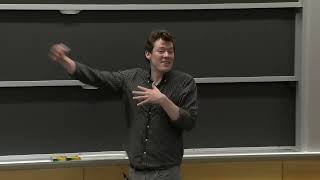
Lecture 14: Folk Theorem
Skills:
Research Methods80%
MIT 14.12 Economic Applications of Game Theory, Fall 2025
Instructor: Ian Ball
View the complete course: https://ocw.mit.edu/courses/14-12-economic-applications-of-game-theory-fall-2025/
YouTube Playlist: https://www.youtube.com/playlist?list=PLUl4u3cNGP63quuKvMHCt3cmTmt0O2qpv
The Folk Theorem states that in infinitely repeated games, any feasible and individually rational payoff can be sustained as a Nash equilibrium (or subgame perfect equilibrium), meaning cooperation, punishment, and a wide range of outcomes become possible when the future matters enough.
License: Creative Commons BY-NC-SA
More information at https://ocw.mit.edu/terms
More courses at https://ocw.mit.edu
Support OCW at http://ow.ly/a1If50zVRlQ
We encourage constructive comments and discussion on OCW’s YouTube and other social media channels. Personal attacks, hate speech, trolling, and inappropriate comments are not allowed and may be removed. More details at https://ocw.mit.edu/comments.
Watch on YouTube ↗
(saves to browser)
Sign in to unlock AI tutor explanation · ⚡30
More on: Research Methods
View skill →






Related AI Lessons
⚡
⚡
⚡
⚡
The ABCs of reading medical research and review papers these days
Medium · LLM
#1 DevLog Meta-research: I Got Tired of Tab Chaos While Reading Research Papers.
Dev.to AI
How to Set Up a Karpathy-Style Wiki for Your Research Field
Medium · AI
The Non-Optimality of Scientific Knowledge: Path Dependence, Lock-In, and The Local Minimum Trap
ArXiv cs.AI
🎓
Tutor Explanation
 DeepCamp AI