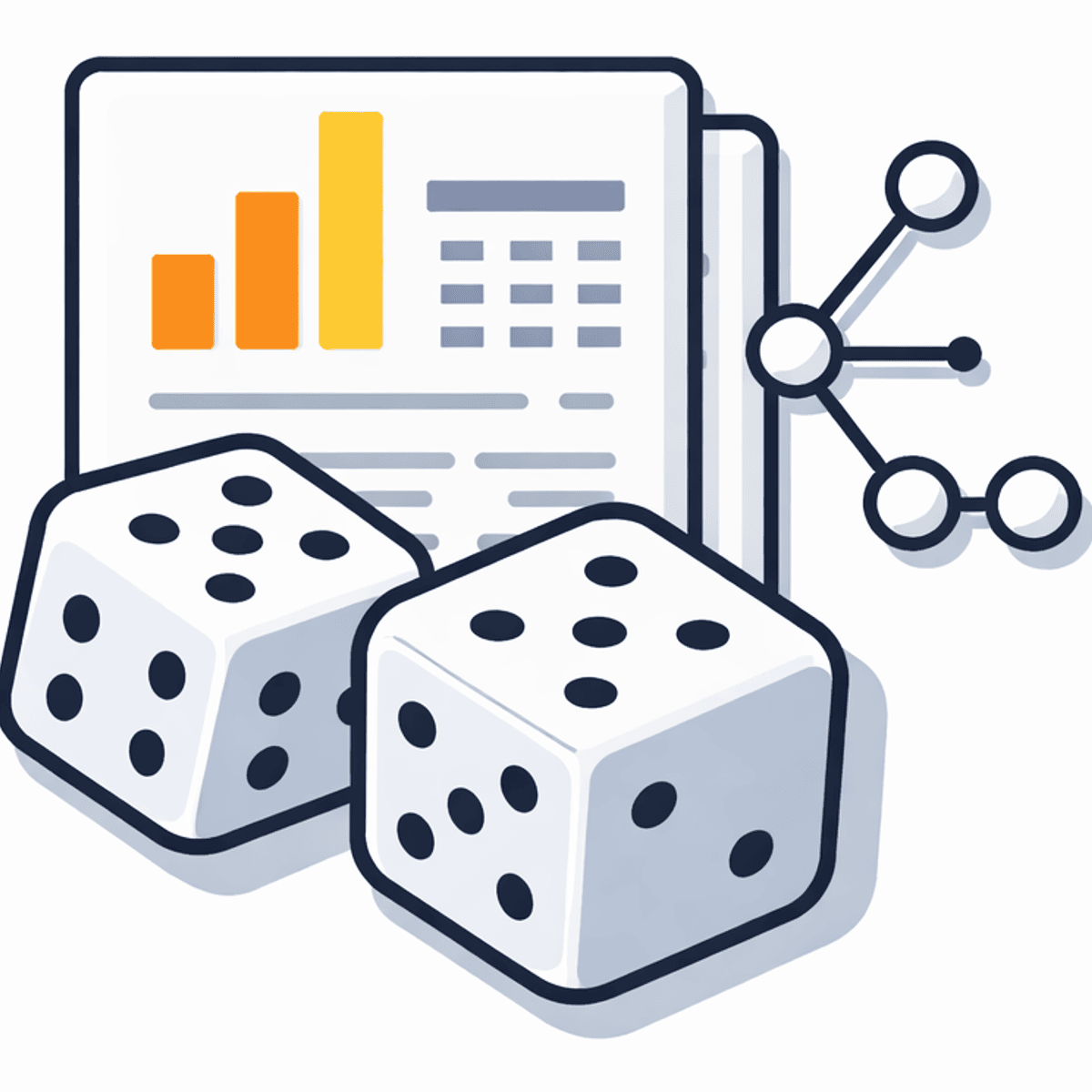
Discrete Math for Computer Science - Counting & Probability
Key Takeaways
Covers Discrete Math for Computer Science, focusing on Counting and Probability techniques
Original Description
This course develops the mathematical tools needed to count, measure uncertainty, and reason about random processes, which are central to computer science, data analysis, and algorithm design. Building on the logical foundations from the first course, it introduces combinatorial counting techniques and probability theory through a discrete, computation-oriented lens.
The course begins with the fundamentals of counting, including the product rule, sum rule, permutations, combinations, and binomial coefficients. You will learn how to count complex structures efficiently using techniques such as the principle of inclusion and exclusion, with applications ranging from algorithm analysis to data organization.
The second half of the course focuses on probability, emphasizing its deep connection to counting. Topics include sample spaces, events, conditional probability, independence, and Bayes’ Theorem. You will also study random variables, probability distributions, expectation, and variance, gaining tools to model and analyze randomized algorithms and real-world uncertainty.
Throughout the course, abstract concepts are reinforced with concrete examples drawn from computing, games of chance, and classic probability puzzles. By the end, learners will be able to systematically count possibilities, compute probabilities, and reason rigorously about randomness—skills essential for advanced study in algorithms, data science, machine learning, and beyond.
Watch on External: Coursera ↗
(saves to browser)
Sign in to unlock AI tutor explanation · ⚡30
🎓
Tutor Explanation
 DeepCamp AI