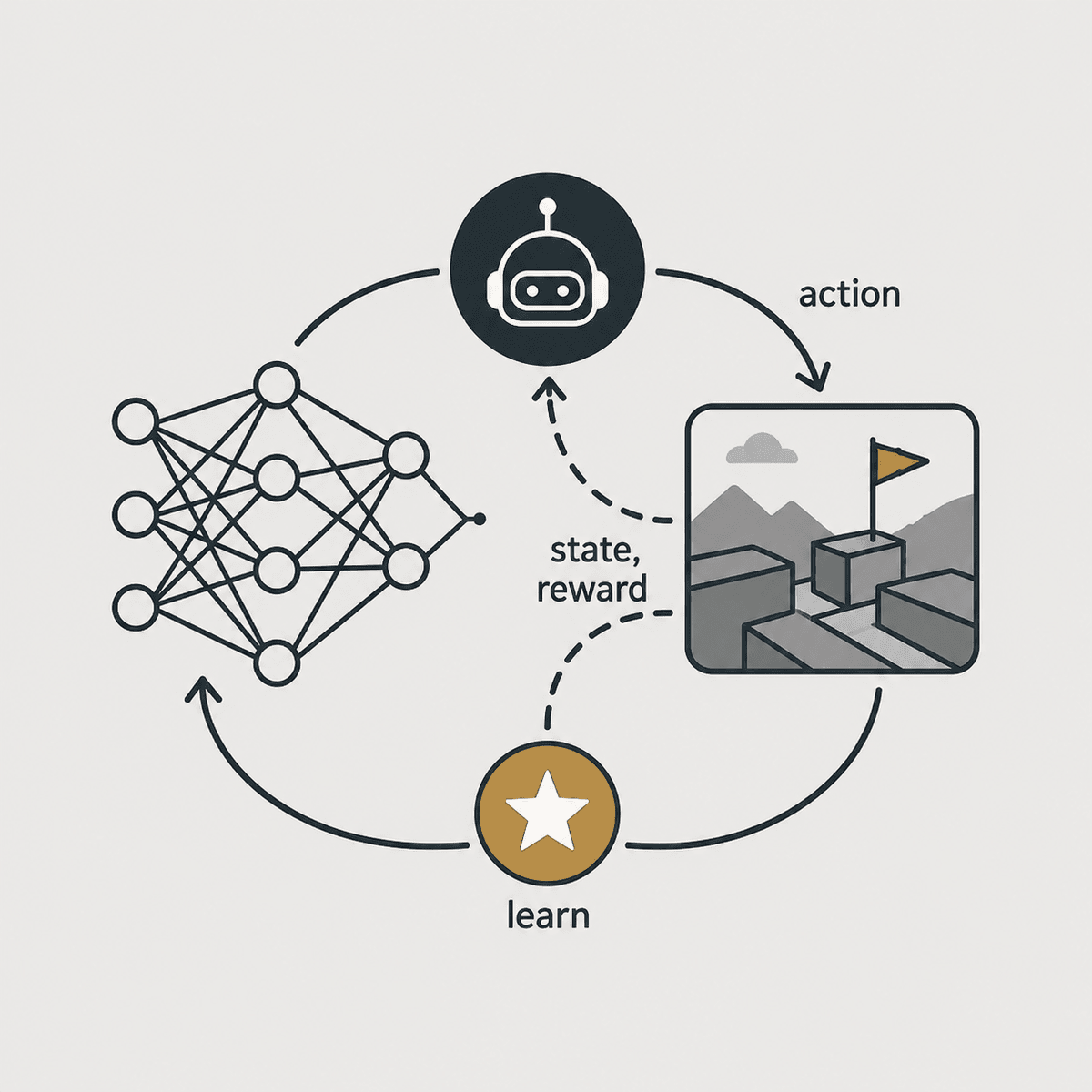
Deep Reinforcement Learning: From Theory to Practice
Skills:
RL Foundations80%
Key Takeaways
Introduces deep reinforcement learning, combining reinforcement learning algorithms with neural network-based function approximation
Original Description
How can reinforcement learning scale beyond small tabular problems to high-dimensional environments such as games, robotics, and autonomous decision-making? This course introduces deep reinforcement learning, where reinforcement-learning algorithms are combined with neural-network-based function approximation.
Learners begin by studying why tabular methods break down in large or continuous state spaces and
how value functions, action-value functions, and policies can be represented by parameterized models.
The course then develops value-based deep reinforcement learning methods, including fitted value
iteration, Deep Q-Networks, replay buffers, target networks, Double DQN, dueling networks, and
prioritized experience replay. Learners also study direct policy optimization through policy-gradient
methods such as REINFORCE, as well as actor–critic methods that combine policy optimization
with value estimation. The course introduces selected modern deep RL algorithms, such as PPO,
DDPG, and SAC, with emphasis on implementation, stability, diagnosis, and empirical evaluation.
By the end of the course, learners will be able to implement deep reinforcement-learning agents,
diagnose common sources of instability, evaluate learned behavior using suitable experimental
protocols, and report results in a reproducible way.
This course can be taken for academic credit as part of CU Boulder’s Masters of Science in Computer Science (MS-CS) and Master of Science in Artificial Intelligence (MS-AI) degrees offered on the Coursera platform. These fully accredited graduate degrees offer targeted courses, short 8-week sessions, and pay-as-you-go tuition. Admission is based on performance in three preliminary courses, not academic history. CU degrees on Coursera are ideal for recent graduates or working professionals. Learn more:
MS in Artificial Intelligence: https://www.coursera.org/degrees/ms-artificial-intelligence-boulder
MS in Computer Science: https://coursera.org/degrees/
Watch on External: Coursera ↗
(saves to browser)
Sign in to unlock AI tutor explanation · ⚡30
More on: RL Foundations
View skill →



![How to Install OpenAI's Universe and Make a Game Bot [LIVE]](https://i.ytimg.com/vi/XI-I9i_GzIw/mqdefault.jpg)

Related Reads
📰
📰
📰
📰
Mastering One Hot Encoding in Machine Learning: A Complete Guide to Encoding Nominal Categorical…
Medium · AI
Mastering One Hot Encoding in Machine Learning: A Complete Guide to Encoding Nominal Categorical…
Medium · Machine Learning
Mastering One Hot Encoding in Machine Learning: A Complete Guide to Encoding Nominal Categorical…
Medium · Data Science
Mastering One Hot Encoding in Machine Learning: A Complete Guide to Encoding Nominal Categorical…
Medium · Python
🎓
Tutor Explanation
 DeepCamp AI