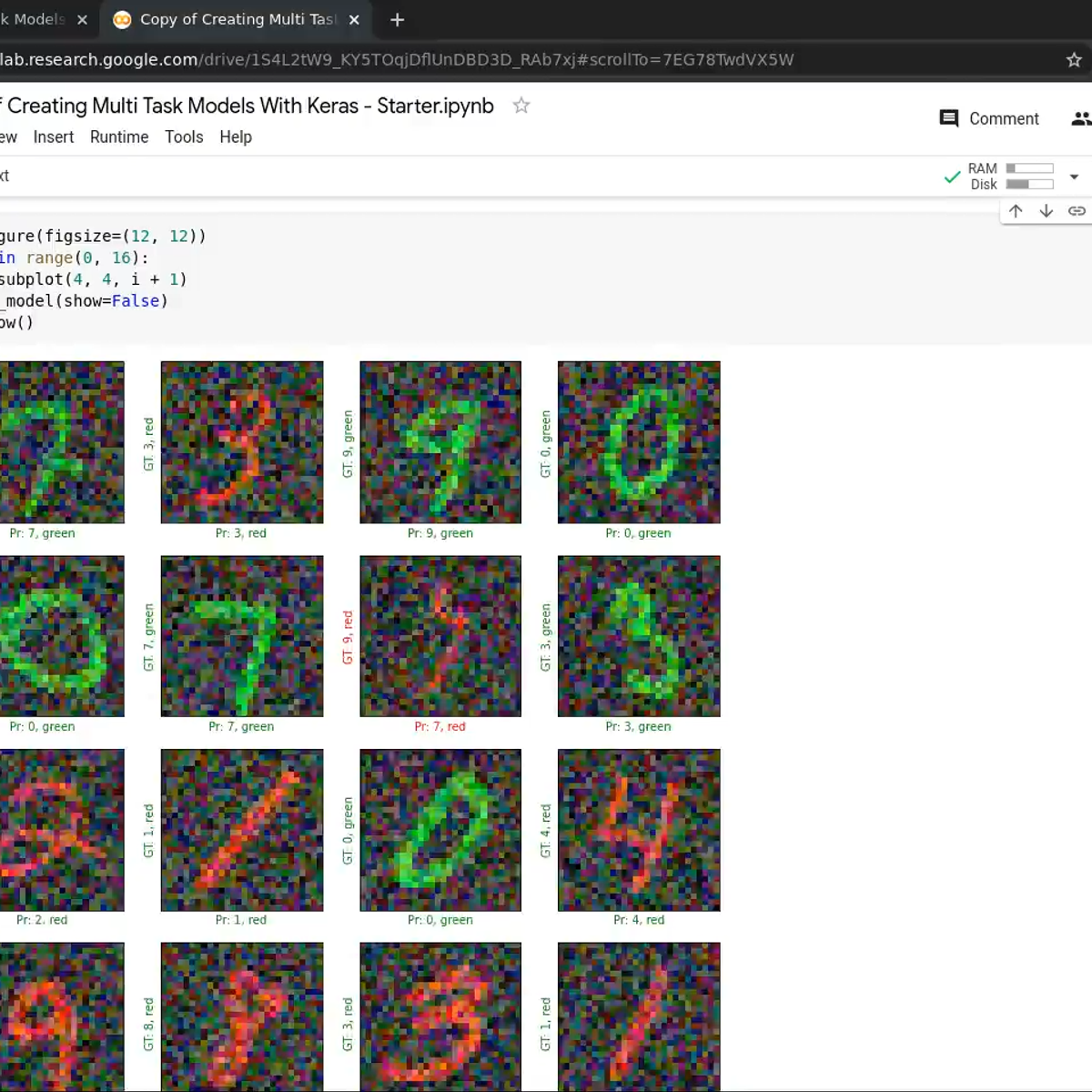
Creating Multi Task Models With Keras
Skills:
Neural Network Basics80%
Key Takeaways
Creates a multi-task model using Keras' functional API to train on two different labels given the same input example
Original Description
In this 1 hour long guided project, you will learn to create and train multi-task, multi-output models with Keras. You will learn to use Keras' functional API to create a multi output model which will be trained to learn two different labels given the same input example. The model will have one input but two outputs. A few of the shallow layers will be shared between the two outputs, you will also use a ResNet style skip connection in the model. If you are familiar with Keras, you have probably come across examples of models that are trained to perform multiple tasks. For example, an object detection model where a CNN is trained to find all class instances in the input images as well as give a regression output to localize the detected class instances in the input. Being able to use Keras' functional API is a first step towards building complex, multi-output models like object detection models.
We will be using TensorFlow as our machine learning framework. The project uses the Google Colab environment. You will need prior programming experience in Python. You will also need prior experience with Keras. Consider this to be an intermediate level Keras project. This is a practical, hands on guided project for learners who already have theoretical understanding of Neural Networks, Convolutional Neural Networks, and optimization algorithms like gradient descent but want to understand how to use use Keras to write custom, more complex models than just plain sequential neural networks.
Note: This course works best for learners who are based in the North America region. We’re currently working on providing the same experience in other regions.
AI explanation not available for this lesson yet
This lesson is still being prepared for the AI tutor. In the meantime, explore lessons that are ready.
Browse explainer-ready lessons →
More on: Neural Network Basics
View skill →





Related Reads
📰
📰
📰
📰
AI/ML Under the Hood — Part 29: CNN Breaking News: Proximity Matters
Medium · Deep Learning
Deep Learning Scientists — Claude Cowork: The Deep Learning Scientist’s New Lab Partner
Medium · Data Science
Why Qwen3.8 27B Looked Brilliant in Testing but Failed to Ship My AI Newspaper
Medium · Deep Learning
The 91% Model: What August’s Benchmarks Reveal About the Real Cost of Staying at the Frontier
Medium · Deep Learning
🎓
Tutor Explanation

 DeepCamp AI