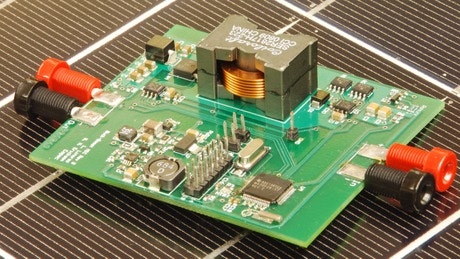
Converter Circuits
This course can also be taken for academic credit as ECEA 5701, part of CU Boulder’s Master of Science in Electrical Engineering degree.
This course introduces more advanced concepts of switched-mode converter circuits. Realization of the power semiconductors in inverters or in converters having bidirectional power flow is explained. Power diodes, power MOSFETs, and IGBTs are explained, along with the origins of their switching times. Equivalent circuit models are refined to include the effects of switching loss. The discontinuous conduction mode is described and analyzed. A number of well-known converter circuit topologies are explored, including those with transformer isolation.
The homework assignments include a boost converter and an H-bridge inverter used in a grid-interfaced solar inverter system, as well as transformer-isolated forward and flyback converters.
After completing this course, you will:
● Understand how to implement the power semiconductor devices in a switching converter
● Understand the origins of the discontinuous conduction mode and be able to solve converters operating in DCM
● Understand the basic dc-dc converter and dc-ac inverter circuits
● Understand how to implement transformer isolation in a dc-dc converter, including the popular forward and flyback converter topologies
Completion of the first course Introduction to Power Electronics is the assumed prerequisite for this course.
Watch on External: Coursera ↗
(saves to browser)
Sign in to unlock AI tutor explanation · ⚡30
Related AI Lessons
⚡
⚡
⚡
⚡
LLM Context Window Management: Strategies and Patterns
Dev.to · Ayi NEDJIMI
Production-Ready Ollama: Deploying GGUF LLMs on CPU-Only Ubuntu 24.04 Servers
Dev.to AI
What AI’s “Recursive Self-Improvement” Actually Means
Medium · AI
Spring AI, RAG, Embeddings, Advisors and Tool Calling
Medium · RAG
🎓
Tutor Explanation

 DeepCamp AI