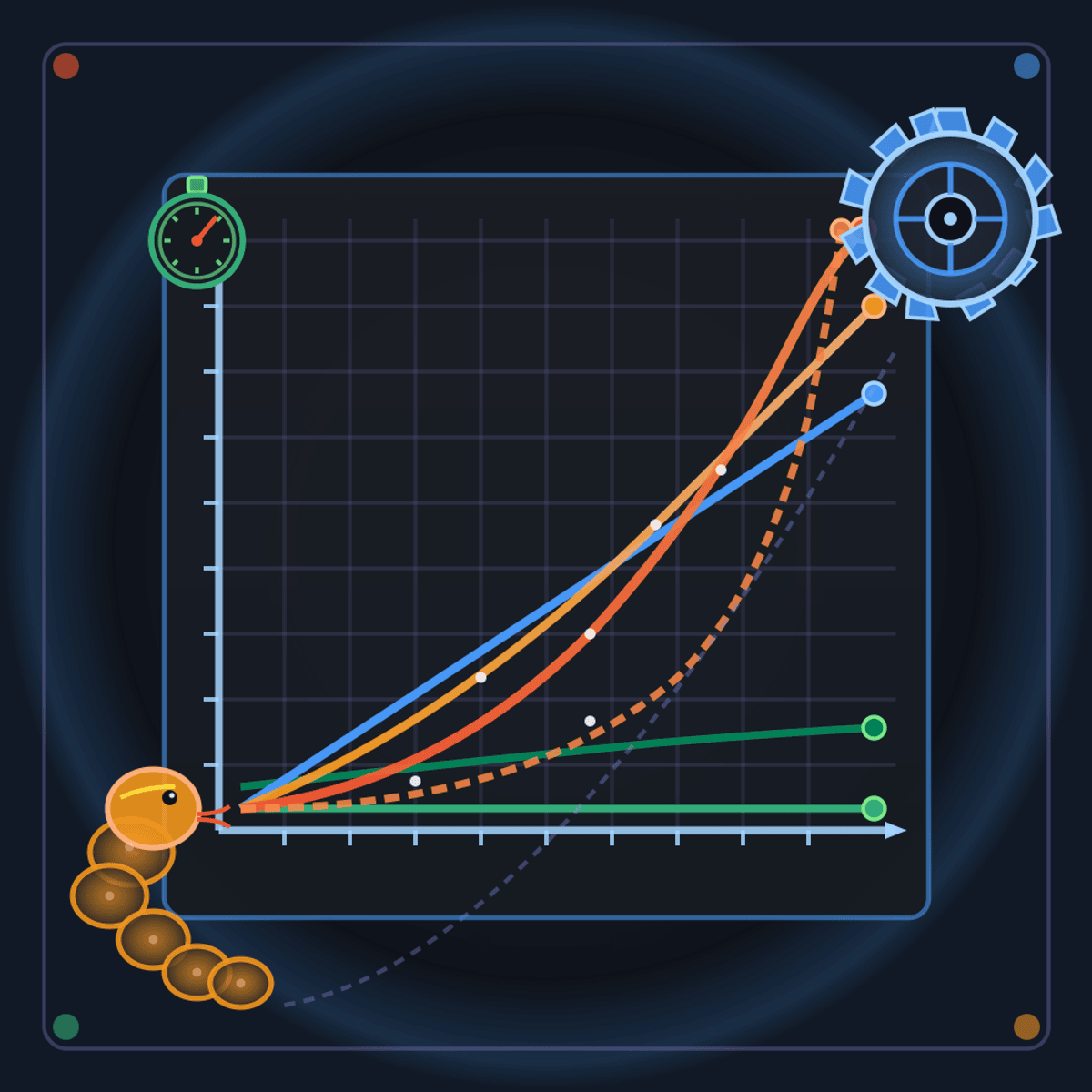
Big O notation: Python to Rust
Skills:
Algorithm Basics90%
Key Takeaways
Explains Big O notation and its application to Python and Rust data structures
Original Description
Big O notation: Python to Rust is a hands-on algorithmic complexity course for engineers transitioning from Python to Rust who want to reason rigorously about how their code scales. You will learn Big O, Big Theta, and Big Omega notation; analyze the time and space complexity of common operations on Python and Rust data structures (list/Vec, dict/HashMap, set/HashSet, tuple, slice, BTreeMap); and compare measured performance in both languages on identical workloads. The course covers amortized analysis, recursion and master theorem, worst case versus expected case, the cost of allocation and borrowing, and how Rust's ownership model affects real-world constants even when asymptotic complexity is identical. You will profile Python code with cProfile and timeit, profile Rust code with criterion and perf, and translate Python algorithms (search, sort, hashing, graph traversal, dynamic programming) into idiomatic Rust while keeping or improving complexity guarantees. By the end of the course, you will be able to predict performance, choose appropriate data structures, justify rewrites from Python to Rust on quantitative grounds, and communicate trade-offs to a team. Part of the Rust for Data Engineering specialization.
Watch on External: Coursera ↗
(saves to browser)
AI explanation not available for this lesson yet
This lesson is still being prepared for the AI tutor. In the meantime, explore lessons that are ready.
Browse explainer-ready lessons →
More on: Algorithm Basics
View skill →





Related Reads
📰
📰
📰
📰
DSA Patterns That Actually Make You Think #5 — Two Pointers: Solving Two Problems with One Pass
Medium · Programming
10 Graph Algorithms in 10 Minutes
Medium · Data Science
Selection Sort Explained With a Bookshelf Story (With Code)
Dev.to · Krunal Kanojiya
LeetCode Journal # 1
Dev.to · Fatima Qaisar
🎓
Tutor Explanation

 DeepCamp AI