Glow: Better reversible generative models
📰 OpenAI News
OpenAI introduces Glow, a reversible generative model using invertible 1x1 convolutions for efficient sampling and attribute manipulation
Action Steps
- Read the Glow research paper to understand the technical details
- Explore the online visualization tool to see Glow's capabilities in action
- Consider applying Glow to problems like speech synthesis, text analysis, and semi-supervised learning
Who Needs to Know This
Machine learning researchers and engineers can benefit from Glow's ability to generate realistic high-resolution images and discover features for attribute manipulation, while product managers can explore its applications in speech synthesis, text analysis, and semi-supervised learning
Key Insight
💡 Glow's invertible 1x1 convolutions enable exact latent-variable inference and log-likelihood evaluation, making it a promising alternative to GANs and VAEs
Share This
🔥 Introducing Glow, a reversible generative model for efficient sampling and attribute manipulation! #AI #MachineLearning
Key Takeaways
OpenAI introduces Glow, a reversible generative model using invertible 1x1 convolutions for efficient sampling and attribute manipulation
Full Article
# Glow: Better reversible generative models | OpenAI
[Skip to main content](https://openai.com/index/glow#main)
[](https://openai.com/)
* [Research](https://openai.com/research/index/)
* Products
* [Business](https://openai.com/business/)
* [Developers](https://openai.com/api/)
* [Company](https://openai.com/about/)
* [Foundation(opens in a new window)](https://openaifoundation.org/)
Log in[Try ChatGPT(opens in a new window)](https://chatgpt.com/?openaicom-did=8001fffb-949f-4ad8-b1ba-2519d068f99a&openaicom_referred=true)
* Research
* Products
* Business
* Developers
* Company
* [Foundation(opens in a new window)](https://openaifoundation.org/)
Glow: Better reversible generative models | OpenAI
Table of contents
* [Motivation](https://openai.com/index/glow#motivation)
* [Results](https://openai.com/index/glow#results)
* [Contribution](https://openai.com/index/glow#contribution)
* [Scale](https://openai.com/index/glow#scale)
* [Directions for research](https://openai.com/index/glow#directions-for-research)
July 9, 2018
[Milestone](https://openai.com/research/index/milestone/)
# Glow: Better reversible generative models
[Read paper(opens in a new window)](https://arxiv.org/abs/1807.03039)[(opens in a new window)](https://github.com/openai/glow)
Share
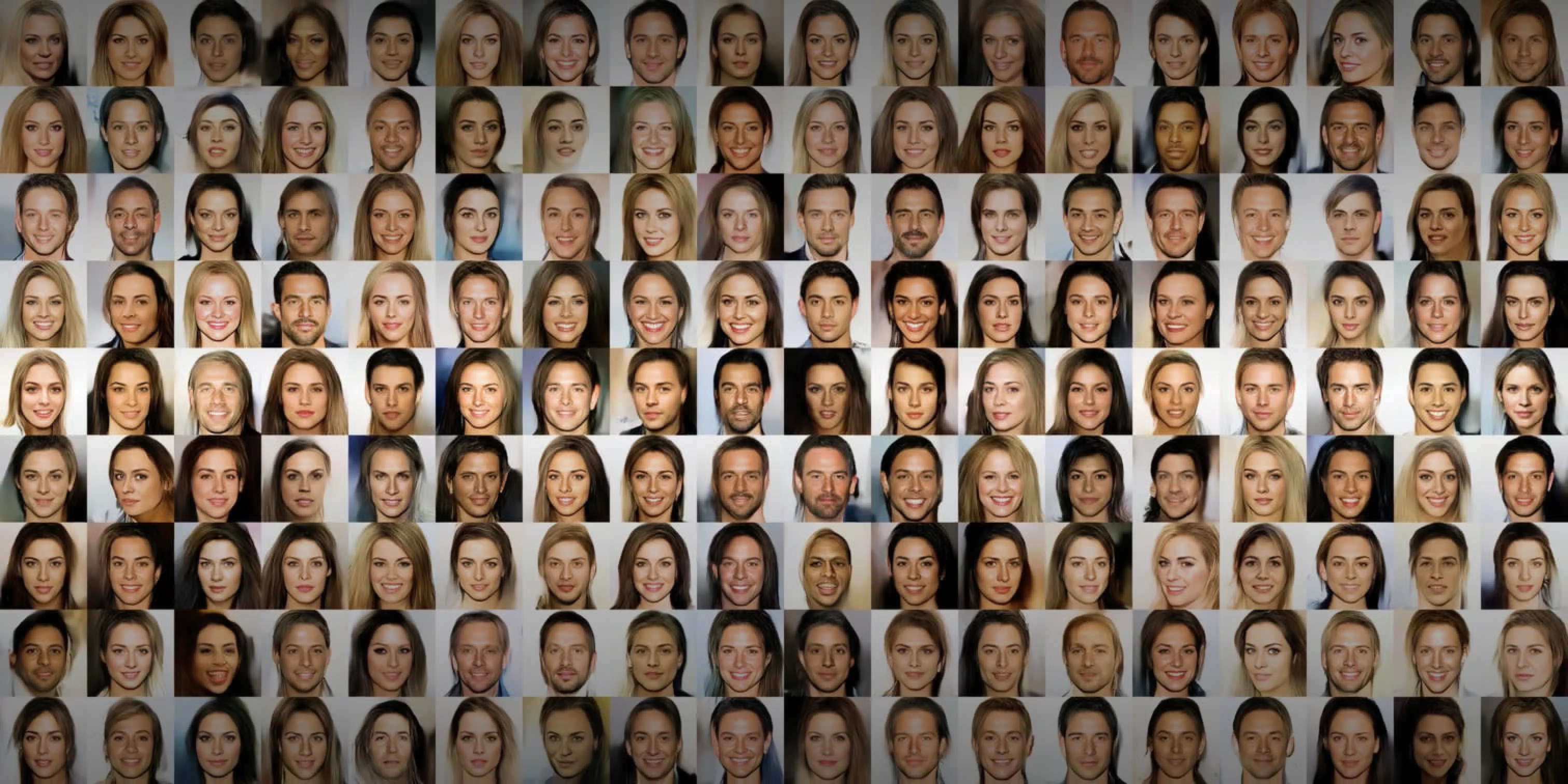
We introduce _Glow_, a reversible generative model which uses invertible 1x1 convolutions. It extends[previous(opens in a new window)](https://arxiv.org/abs/1410.8516)[work(opens in a new window)](https://arxiv.org/abs/1605.08803)on reversible generative models and simplifies the architecture. Our model can generate realistic high resolution images, supports efficient sampling, and discovers features that can be used to manipulate attributes of data. We’re releasing code for the model and an online visualization tool so people can explore and build on these results.
An interactive demo of our model to manipulate attributes of your face, and blend with other faces
## Motivation
Manipulating attributes of images of researchers Prafulla Dhariwal and Durk Kingma. The model isn’t given attribute labels at training time, yet it learns a latent space where certain directions correspond to changes in attributes like beard density, age, hair color, and so on.
Generative modeling is about observing data, like a set of pictures of faces, then learning a model of how this data was generated. Learning to approximate the data-generating process requires learning _all structure_ present in the data, and successful models should be able to synthesize outputs that look similar to the data. Accurate generative models have broad applications, including[speech synthesis(opens in a new window)](https://arxiv.org/abs/1609.03499),[text analysis and synthesis(opens in a new window)](https://blog.openai.com/language-unsupervised/),[semi-supervised learning(opens in a new window)](https://arxiv.org/abs/1406.5298)and[model-based control(opens in a new window)](https://arxiv.org/abs/1803.10122). The technique we propose can be applied to those problems as well.
Glow is a type of reversible generative model, also called _flow-based generative model_, and is an extension of the[NICE(opens in a new window)](https://arxiv.org/abs/1410.8516)and[RealNVP(opens in a new window)](https://arxiv.org/abs/1605.08803)techniques. Flow-based generative models have so far gained little attention in the research community compared to[GANs(opens in a new window)](https://en.wikipedia.org/wiki/Generative_adversarial_network)and[VAEs(opens in a new window)](https://arxiv.org/abs/1312.6114).
Some of the merits of flow-based generative models include:
* Exact latent-variable inference and log-likelihood evaluation. In VAEs, one is able to infer only approximately the val
[Skip to main content](https://openai.com/index/glow#main)
[](https://openai.com/)
* [Research](https://openai.com/research/index/)
* Products
* [Business](https://openai.com/business/)
* [Developers](https://openai.com/api/)
* [Company](https://openai.com/about/)
* [Foundation(opens in a new window)](https://openaifoundation.org/)
Log in[Try ChatGPT(opens in a new window)](https://chatgpt.com/?openaicom-did=8001fffb-949f-4ad8-b1ba-2519d068f99a&openaicom_referred=true)
* Research
* Products
* Business
* Developers
* Company
* [Foundation(opens in a new window)](https://openaifoundation.org/)
Glow: Better reversible generative models | OpenAI
Table of contents
* [Motivation](https://openai.com/index/glow#motivation)
* [Results](https://openai.com/index/glow#results)
* [Contribution](https://openai.com/index/glow#contribution)
* [Scale](https://openai.com/index/glow#scale)
* [Directions for research](https://openai.com/index/glow#directions-for-research)
July 9, 2018
[Milestone](https://openai.com/research/index/milestone/)
# Glow: Better reversible generative models
[Read paper(opens in a new window)](https://arxiv.org/abs/1807.03039)[(opens in a new window)](https://github.com/openai/glow)

Share
We introduce _Glow_, a reversible generative model which uses invertible 1x1 convolutions. It extends[previous(opens in a new window)](https://arxiv.org/abs/1410.8516)[work(opens in a new window)](https://arxiv.org/abs/1605.08803)on reversible generative models and simplifies the architecture. Our model can generate realistic high resolution images, supports efficient sampling, and discovers features that can be used to manipulate attributes of data. We’re releasing code for the model and an online visualization tool so people can explore and build on these results.
An interactive demo of our model to manipulate attributes of your face, and blend with other faces
## Motivation
Manipulating attributes of images of researchers Prafulla Dhariwal and Durk Kingma. The model isn’t given attribute labels at training time, yet it learns a latent space where certain directions correspond to changes in attributes like beard density, age, hair color, and so on.
Generative modeling is about observing data, like a set of pictures of faces, then learning a model of how this data was generated. Learning to approximate the data-generating process requires learning _all structure_ present in the data, and successful models should be able to synthesize outputs that look similar to the data. Accurate generative models have broad applications, including[speech synthesis(opens in a new window)](https://arxiv.org/abs/1609.03499),[text analysis and synthesis(opens in a new window)](https://blog.openai.com/language-unsupervised/),[semi-supervised learning(opens in a new window)](https://arxiv.org/abs/1406.5298)and[model-based control(opens in a new window)](https://arxiv.org/abs/1803.10122). The technique we propose can be applied to those problems as well.
Glow is a type of reversible generative model, also called _flow-based generative model_, and is an extension of the[NICE(opens in a new window)](https://arxiv.org/abs/1410.8516)and[RealNVP(opens in a new window)](https://arxiv.org/abs/1605.08803)techniques. Flow-based generative models have so far gained little attention in the research community compared to[GANs(opens in a new window)](https://en.wikipedia.org/wiki/Generative_adversarial_network)and[VAEs(opens in a new window)](https://arxiv.org/abs/1312.6114).
Some of the merits of flow-based generative models include:
* Exact latent-variable inference and log-likelihood evaluation. In VAEs, one is able to infer only approximately the val
 DeepCamp AI