🔬Doing Vibe Physics — Alex Lupsasca, OpenAI
📰 Latent Space
Learn how Alex Lupsasca, OpenAI, uses GPT-5.x to derive new results in theoretical physics and quantum gravity, and how AI is pushing the limits of scientific research
Action Steps
- Explore the capabilities of GPT-5.x in theoretical physics and quantum gravity
- Use AI to assist in complex calculations and derive new results
- Investigate the potential of AI in advancing scientific research and pushing the limits of human understanding
- Apply AI tools to reproduce and build upon existing research
- Collaborate with AI researchers to develop new methods and techniques for scientific inquiry
Who Needs to Know This
Theoretical physicists and AI researchers can benefit from this article, as it showcases the potential of AI in advancing scientific knowledge and pushing the boundaries of human understanding
Key Insight
💡 AI can significantly accelerate and augment scientific research, enabling breakthroughs and discoveries that may have been previously impossible
Share This
🔬 AI is revolutionizing theoretical physics! Learn how GPT-5.x is helping researchers derive new results and push the boundaries of human understanding 🚀
Key Takeaways
Learn how Alex Lupsasca, OpenAI, uses GPT-5.x to derive new results in theoretical physics and quantum gravity, and how AI is pushing the limits of scientific research
Full Article
Title: 🔬Doing Vibe Physics — Alex Lupsasca, OpenAI
URL Source: https://www.latent.space/p/lupsasca
Published Time: 2026-05-05T20:34:11+00:00
Markdown Content:
# 🔬Doing Vibe Physics — Alex Lupsasca, OpenAI - Latent.Space
[](https://www.latent.space/)
# [](https://www.latent.space/)
Subscribe Sign in
[](https://www.latent.space/)
Latent Space: The AI Engineer Podcast
🔬Doing Vibe Physics — Alex Lupsasca, OpenAI
6
1×
0:00
Current time: 0:00 / Total time: -1:31:50
-1:31:50
Audio playback is not supported on your browser. Please upgrade.
## 🔬Doing Vibe Physics — Alex Lupsasca, OpenAI
The full story of how GPT‑5.x derived new results in theoretical physics and quantum gravity.
May 05, 2026
6
Share
Transcript
Some people are going crazy over GPT 5.5. _Some_ people. This is the story of the [Jagged](https://www.notion.so/Tanishq-https-x-com-iScienceLuvr-2c312774e7a88187a391e2a67b42cd56?pvs=21)[Frontier](https://www.hbs.edu/faculty/Pages/item.aspx?num=64700). People who use AI to write emails or even code implementation work [find the lift moderate](https://www.reddit.com/r/codex/comments/1su4jik/did_gpt55_actually_impress_you_or_does_it_feel/) whereas people pushing the limits of the model are figuring out that the [limits just moved outwards](https://www.youtube.com/watch?v=kCMgUvnpzsM).
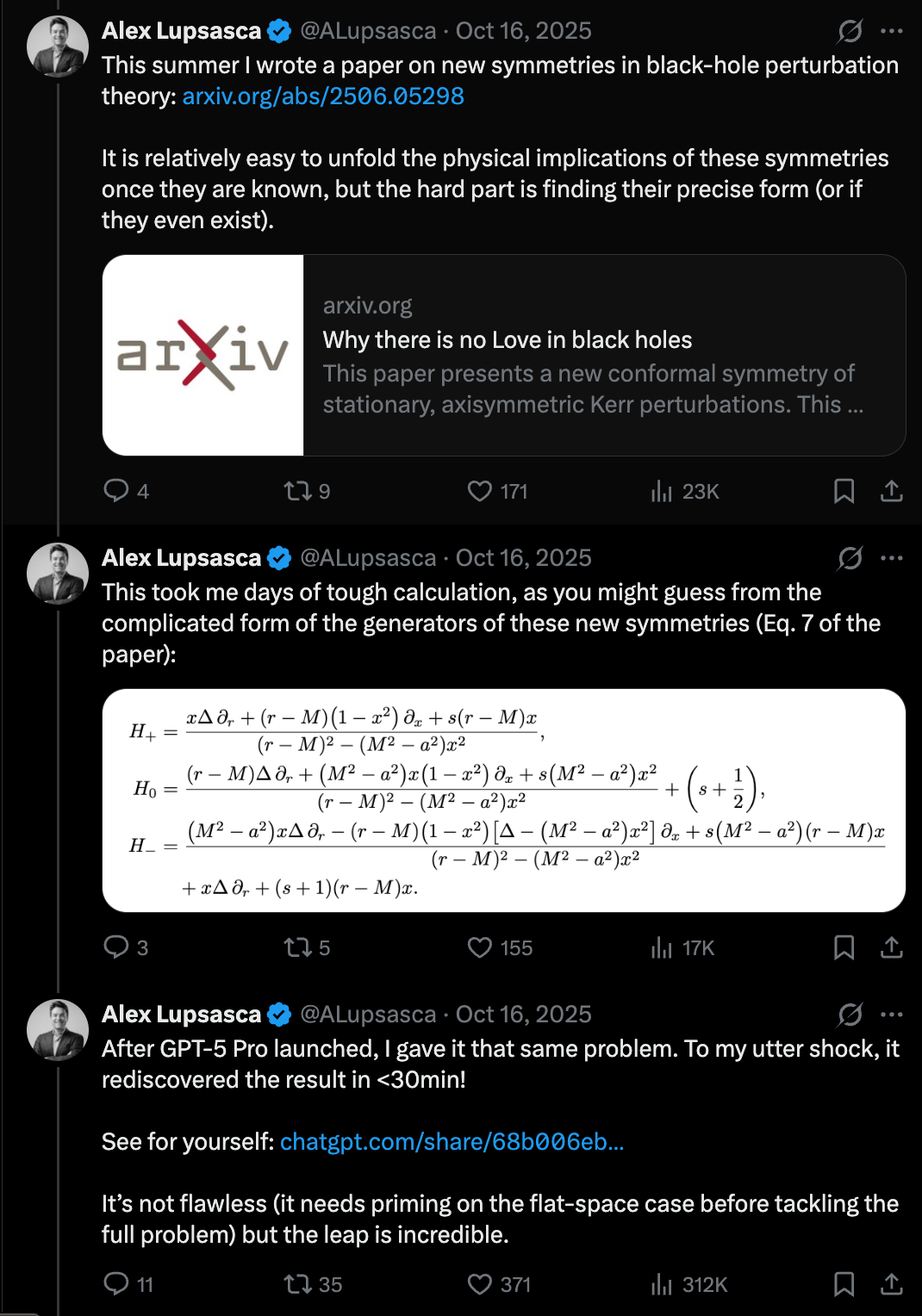
[Alex Lupsaska](https://lupsasca.com/) has been tracking this limit for a year and a half now. “When GPT5 came out, it was **able to reproduce one of my best papers**(that took a very long time to come up with)**in 30 minutes**.”
But Alex also notes that this shift was mostly invisible.
> _I remember when GPT-5 came out… on Twitter, the reception was lukewarm. A lot of people were like, well, we expected a lot more, and it’s not better at writing email. And I remember thinking, well, okay, GPT-3 could write email. How much better can it get at writing email? That’s not the point. **But at the science frontier, the capabilities were really taking off.**_
We walk through his paper and more with him in today’s Science pod! [Watch here](https://youtu.be/9d899Ram9Bs).
## The “Oscar for physics”
Alex made an early splash in his career with breakthroughs in our understanding of black holes. He’s also known for [Black Hole Explorer](https://www.sciencenews.org/article/alex-lupsasca-black-hole-photon-ring) and [an iPhone app that makes visualizing black holes fun and interactive to regular audiences](https://arxiv.org/abs/2603.05810). Alex won the 2024 New Horizons in Fundamental Physics Breakthrough Prize. Known as the “Oscar for physics” this is arguably the most prestigious prize an early stage theoretical physicist can win.[1](https://www.latent.space/p/lupsasca#footnote-1)
Alex first saw promise for AI in theoretical physics after he asked o3 for help on his research. In the podcast, Alex recalls asking GPT for help with a calculation that would have taken days, and getting a result in eleven minutes.
[](https://su
URL Source: https://www.latent.space/p/lupsasca
Published Time: 2026-05-05T20:34:11+00:00
Markdown Content:
# 🔬Doing Vibe Physics — Alex Lupsasca, OpenAI - Latent.Space
[](https://www.latent.space/)
# [](https://www.latent.space/)
Subscribe Sign in
[](https://www.latent.space/)
Latent Space: The AI Engineer Podcast
🔬Doing Vibe Physics — Alex Lupsasca, OpenAI
6
1×
0:00
Current time: 0:00 / Total time: -1:31:50
-1:31:50
Audio playback is not supported on your browser. Please upgrade.
## 🔬Doing Vibe Physics — Alex Lupsasca, OpenAI
The full story of how GPT‑5.x derived new results in theoretical physics and quantum gravity.
May 05, 2026
6
Share
Transcript
Some people are going crazy over GPT 5.5. _Some_ people. This is the story of the [Jagged](https://www.notion.so/Tanishq-https-x-com-iScienceLuvr-2c312774e7a88187a391e2a67b42cd56?pvs=21)[Frontier](https://www.hbs.edu/faculty/Pages/item.aspx?num=64700). People who use AI to write emails or even code implementation work [find the lift moderate](https://www.reddit.com/r/codex/comments/1su4jik/did_gpt55_actually_impress_you_or_does_it_feel/) whereas people pushing the limits of the model are figuring out that the [limits just moved outwards](https://www.youtube.com/watch?v=kCMgUvnpzsM).
[Alex Lupsaska](https://lupsasca.com/) has been tracking this limit for a year and a half now. “When GPT5 came out, it was **able to reproduce one of my best papers**(that took a very long time to come up with)**in 30 minutes**.”
But Alex also notes that this shift was mostly invisible.
> _I remember when GPT-5 came out… on Twitter, the reception was lukewarm. A lot of people were like, well, we expected a lot more, and it’s not better at writing email. And I remember thinking, well, okay, GPT-3 could write email. How much better can it get at writing email? That’s not the point. **But at the science frontier, the capabilities were really taking off.**_
We walk through his paper and more with him in today’s Science pod! [Watch here](https://youtu.be/9d899Ram9Bs).
## The “Oscar for physics”
Alex made an early splash in his career with breakthroughs in our understanding of black holes. He’s also known for [Black Hole Explorer](https://www.sciencenews.org/article/alex-lupsasca-black-hole-photon-ring) and [an iPhone app that makes visualizing black holes fun and interactive to regular audiences](https://arxiv.org/abs/2603.05810). Alex won the 2024 New Horizons in Fundamental Physics Breakthrough Prize. Known as the “Oscar for physics” this is arguably the most prestigious prize an early stage theoretical physicist can win.[1](https://www.latent.space/p/lupsasca#footnote-1)
Alex first saw promise for AI in theoretical physics after he asked o3 for help on his research. In the podcast, Alex recalls asking GPT for help with a calculation that would have taken days, and getting a result in eleven minutes.
[](https://su




 DeepCamp AI