Continual learning for AI agents
📰 LangChain Blog
Continual learning for AI agents occurs at three layers: model, harness, and context, enabling systems to improve over time
Action Steps
- Identify the three layers of agentic systems: model, harness, and context
- Understand the techniques for updating model weights, such as SFT and RL
- Recognize the challenge of catastrophic forgetting and its impact on model performance
- Explore the concept of harnesses and their role in driving agents
- Consider the importance of context in configuring and improving agents
Who Needs to Know This
AI engineers, researchers, and developers can benefit from understanding these layers to build more effective agentic systems, and product managers can use this knowledge to design better AI-powered products
Key Insight
💡 Continual learning is not limited to updating model weights, but can also occur at the harness and context layers
Share This
🤖 Continual learning for AI agents happens at 3 layers: model, harness, and context! 🚀
Key Takeaways
Continual learning for AI agents occurs at three layers: model, harness, and context, enabling systems to improve over time
Full Article
Published Time: 2026-04-05T21:46:30.000Z
# Continual learning for AI agents
[Skip to content](https://blog.langchain.com/continual-learning-for-ai-agents/#main)
[](https://blog.langchain.com/)
* [Website](https://www.langchain.com/)
* [Docs](https://docs.langchain.com/)
* [Case Studies](https://blog.langchain.com/tag/case-studies/)
* [Harrison's In the Loop Series](https://blog.langchain.com/tag/in-the-loop/)
* [Try LangSmith](https://smith.langchain.com/)
[Sign in](https://blog.langchain.com/continual-learning-for-ai-agents/#/portal/signin)[Subscribe](https://blog.langchain.com/continual-learning-for-ai-agents/#/portal/signup)
# Continual learning for AI agents
[Harrison's In the Loop Series](https://blog.langchain.com/tag/in-the-loop/)4 min read Apr 5, 2026
[](https://x.com/hwchase17?ref=blog.langchain.com)[](https://x.com/hwchase17/article/2040467997022884194/media/2040467721792659456?ref=blog.langchain.com)Most discussions of continual learning in AI focus on one thing: updating model weights. But for AI agents, learning can happen at three distinct layers: the model, the harness, and the context. Understanding the difference changes how you think about building systems that improve over time.
The three main layers of agentic systems are:
* Model: the model weights themselves.
* Harness: the harness around the model that powers all instances of the agent. This refers to the code that drives the agent, as well as any instructions or tools that are always part of the harness.
* Context: additional context (instructions, skills) that lives outside the harness, and can be used to configure it.
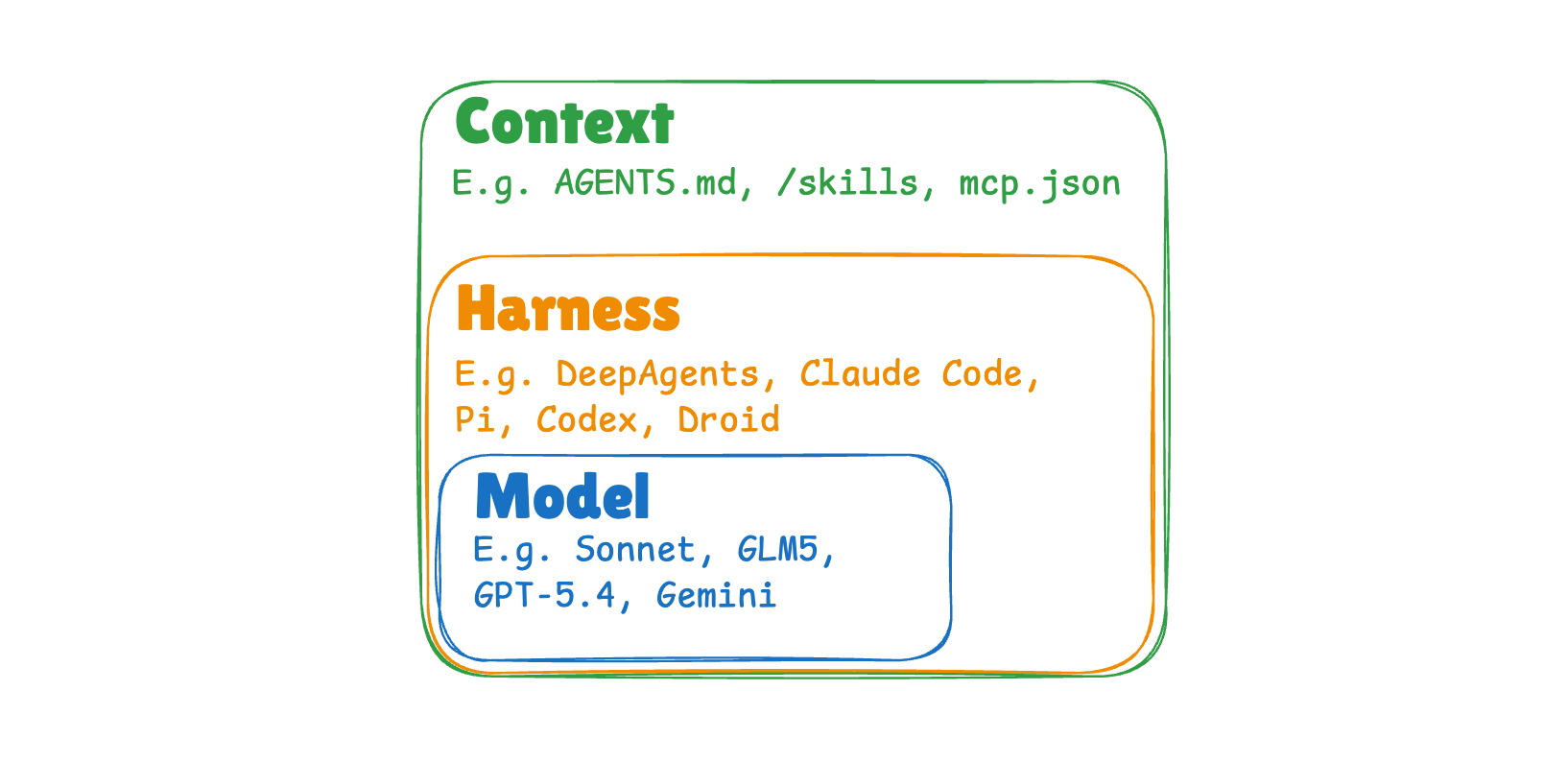
[](https://x.com/hwchase17/article/2040467997022884194/media/2040466639616126976?ref=blog.langchain.com)_**Example #1**:_ Mapping this a coding agent like Claude Code:
* Model: claude-sonnet, etc
* Harness: Claude Code
* User context: [CLAUDE.md](http://claude.md/?ref=blog.langchain.com), /skills, mcp.json
_**Example #2**:_ Mapping this to OpenClaw:
* Model: many
* Harness: Pi + some other scaffolding
* Agent context: [SOUL.md](http://soul.md/?ref=blog.langchain.com), skills from clawhub
When we talk about continual learning, most people jump immediately to the model. But in reality - an AI system can _learn_ at all three of these levels.
## Continual learning at the model layer
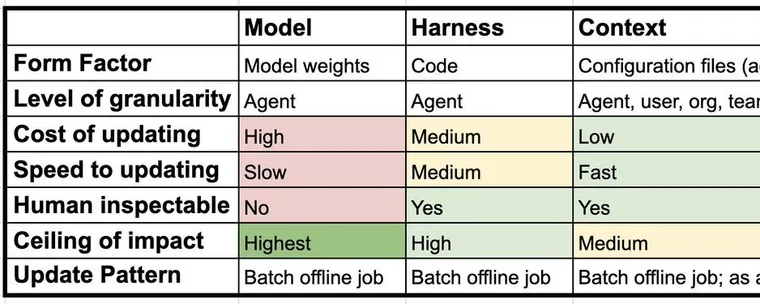
When most people talk about continual learning, this is what they most commonly refer to: updating the model weights.
Techniques to update this include [SFT](https://cameronrwolfe.substack.com/p/understanding-and-using-supervised?ref=blog.langchain.com), RL (e.g. [GRPO](https://cameronrwolfe.substack.com/p/grpo?ref=blog.langchain.com)), etc.
A central challenge here is**catastrophic forgetting**— when a model is updated on new data or tasks, it tends to degrade on things it previously knew. This is an open research problem.
When people do train models for a specific agentic system (e.g. you could view the OpenAI codex models as being trained for their Codex agent) they largely do this for the agentic system as a whole. In theory, you could do this at a more granular level (e.g. you could have a [LORA](https://unsloth.ai/docs/get-started/fine-tuning-llms-guide/lora-hyperparameters-guide?ref=blog.langchain.com) per user) but in practice this is mostly done at the agent level.
## Continual learning at the harness layer
As defined earlier, the harness refers to the code that drives the agent, as well as any instructions or tools that are always part of the harness.
As [harnesses](https://blog.langchain.com/the-anatomy-of-an-agent-harness/) have become more popular, there have
# Continual learning for AI agents
[Skip to content](https://blog.langchain.com/continual-learning-for-ai-agents/#main)
[](https://blog.langchain.com/)
* [Website](https://www.langchain.com/)
* [Docs](https://docs.langchain.com/)
* [Case Studies](https://blog.langchain.com/tag/case-studies/)
* [Harrison's In the Loop Series](https://blog.langchain.com/tag/in-the-loop/)
* [Try LangSmith](https://smith.langchain.com/)
[Sign in](https://blog.langchain.com/continual-learning-for-ai-agents/#/portal/signin)[Subscribe](https://blog.langchain.com/continual-learning-for-ai-agents/#/portal/signup)

# Continual learning for AI agents
[Harrison's In the Loop Series](https://blog.langchain.com/tag/in-the-loop/)4 min read Apr 5, 2026
[](https://x.com/hwchase17?ref=blog.langchain.com)[](https://x.com/hwchase17/article/2040467997022884194/media/2040467721792659456?ref=blog.langchain.com)Most discussions of continual learning in AI focus on one thing: updating model weights. But for AI agents, learning can happen at three distinct layers: the model, the harness, and the context. Understanding the difference changes how you think about building systems that improve over time.
The three main layers of agentic systems are:
* Model: the model weights themselves.
* Harness: the harness around the model that powers all instances of the agent. This refers to the code that drives the agent, as well as any instructions or tools that are always part of the harness.
* Context: additional context (instructions, skills) that lives outside the harness, and can be used to configure it.

[](https://x.com/hwchase17/article/2040467997022884194/media/2040466639616126976?ref=blog.langchain.com)_**Example #1**:_ Mapping this a coding agent like Claude Code:
* Model: claude-sonnet, etc
* Harness: Claude Code
* User context: [CLAUDE.md](http://claude.md/?ref=blog.langchain.com), /skills, mcp.json
_**Example #2**:_ Mapping this to OpenClaw:
* Model: many
* Harness: Pi + some other scaffolding
* Agent context: [SOUL.md](http://soul.md/?ref=blog.langchain.com), skills from clawhub
When we talk about continual learning, most people jump immediately to the model. But in reality - an AI system can _learn_ at all three of these levels.
## Continual learning at the model layer
When most people talk about continual learning, this is what they most commonly refer to: updating the model weights.
Techniques to update this include [SFT](https://cameronrwolfe.substack.com/p/understanding-and-using-supervised?ref=blog.langchain.com), RL (e.g. [GRPO](https://cameronrwolfe.substack.com/p/grpo?ref=blog.langchain.com)), etc.
A central challenge here is**catastrophic forgetting**— when a model is updated on new data or tasks, it tends to degrade on things it previously knew. This is an open research problem.
When people do train models for a specific agentic system (e.g. you could view the OpenAI codex models as being trained for their Codex agent) they largely do this for the agentic system as a whole. In theory, you could do this at a more granular level (e.g. you could have a [LORA](https://unsloth.ai/docs/get-started/fine-tuning-llms-guide/lora-hyperparameters-guide?ref=blog.langchain.com) per user) but in practice this is mostly done at the agent level.
## Continual learning at the harness layer
As defined earlier, the harness refers to the code that drives the agent, as well as any instructions or tools that are always part of the harness.
As [harnesses](https://blog.langchain.com/the-anatomy-of-an-agent-harness/) have become more popular, there have

 DeepCamp AI